
"Scope is the invisible force that determines whether your leadership feels smooth and strategic—or not."
Adam Kreek
Founder Built for Hard
Understanding Scope: The Leadership Skill You Didn’t Know You Needed (Until Everything Became Your Problem)
posted in Business Coaching
Contents
If you’ve ever built a business, stepped into an executive role, or inherited a team that feels like a hybrid of daycare, crisis centre, and Formula 1 pit crew, you’ve already encountered leadership scope—you just didn’t have a name for it.
Scope is the invisible force that determines whether your leadership feels smooth and strategic—or like you’re rowing upstream with one oar and a hole in your boat. As your business evolves, gets acquired, or enters a new season, your scope shifts with it. Some leaders adjust with finesse; others swallow river water.
Let’s avoid unnecessary swimming.
What Is Leadership Scope?
In simple terms:
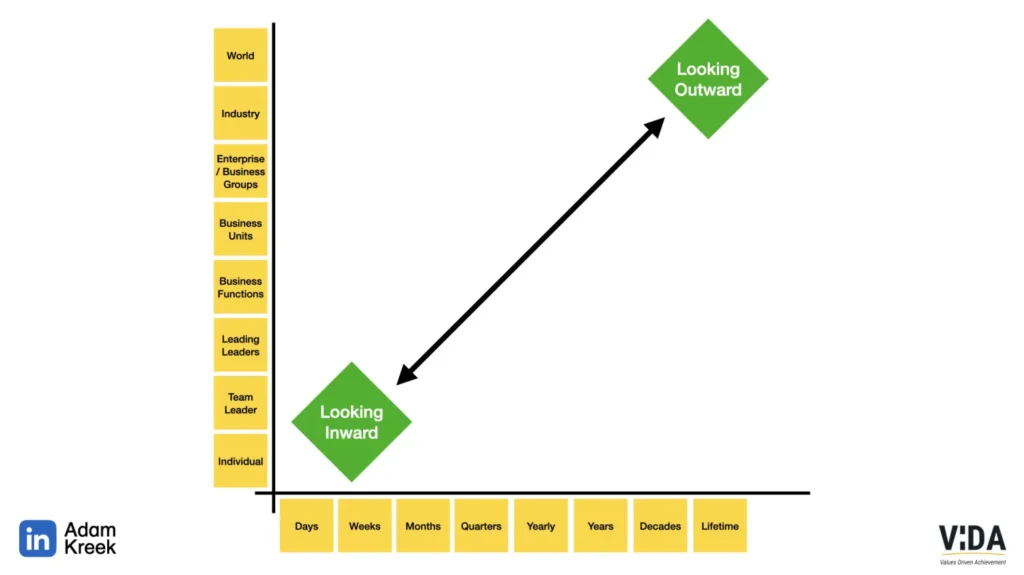
Leadership scope = who you lead + how far ahead you must think.
It includes:
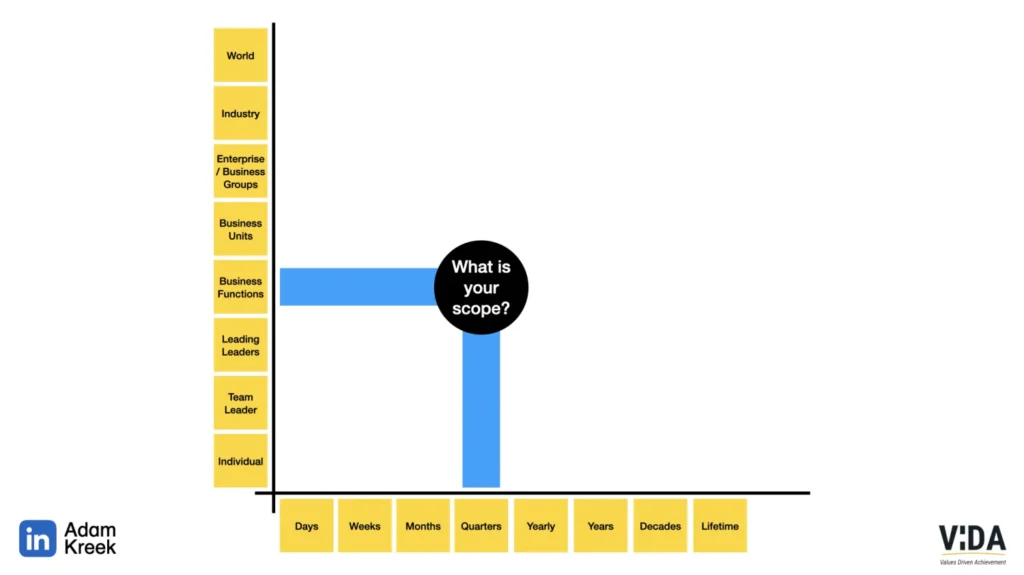
Vertical responsibility:
individual → team → function → business unit → enterprise → industry → world
Time horizon:
days → weeks → months → quarters → years → decades → lifetime
Put these axes together and you get your leadership weight class.
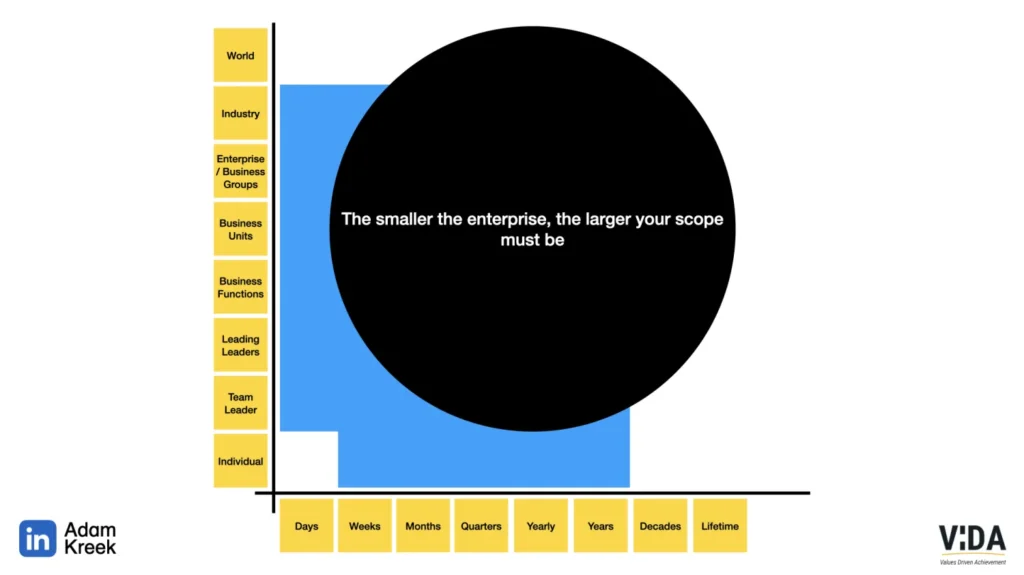
For entrepreneurs in early growth or founder transition, scope is massive. Payroll, product vision, hiring, sales, operations, HR, finance—and occasionally plunging the office toilet. This is why scaling a business feels like mental CrossFit.
As organizations professionalize—especially under private equity or structured growth—scope should narrow, deepen, and expand forward in time. Most leaders don’t make the shift quickly enough. That creates drag, misalignment, and overwhelm.
This is leadership scope in action.
Why Scope Matters for Entrepreneurs and Executives
Early entrepreneurs carry enormous scope because nobody else exists to take it.
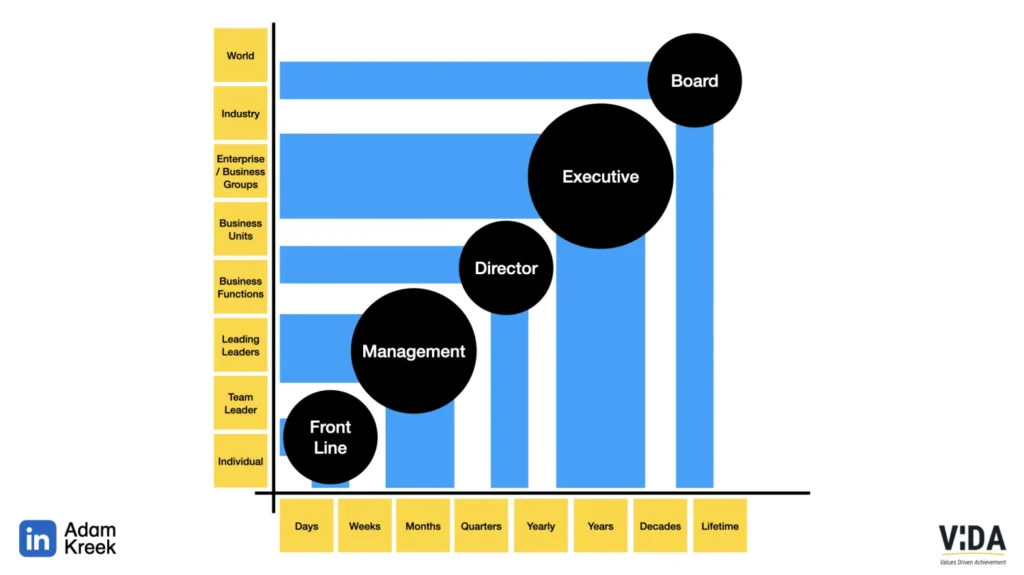
Executives in maturing organizations must redefine their scope to focus on:
The tension between these worlds creates familiar friction:
- Founders struggle to let go.
- New executives cling to old tasks.
- Managers attempt to win through effort instead of altitude.
- The front line thinks leadership is out of touch.
- Leadership thinks the front line lacks big-picture vision.
Scope explains these mismatches.
It also solves them.
When leadership scope is understood and aligned, organizational clarity increases and performance rises—dramatically.
How to Align Leadership Scope With Organizational Growth
Effective strategic deployment requires leaders to operate at the correct altitude. Here’s how scope evolves as organizations grow:
- Start-up: Everyone does everything. Scope is wide, chaotic, urgent.
- Fast growth: Leadership must shift from doing → deciding.
- Scaling a business: Systems, processes, and team accountability reduce scope overload.
- Organizational maturity: Scope becomes layered and distributed.
- Private equity / enterprise: Executive leadership thinks in years and enterprise value, not weeks and tasks.
Leaders must adjust their scope intentionally or risk becoming the organizational bottleneck.
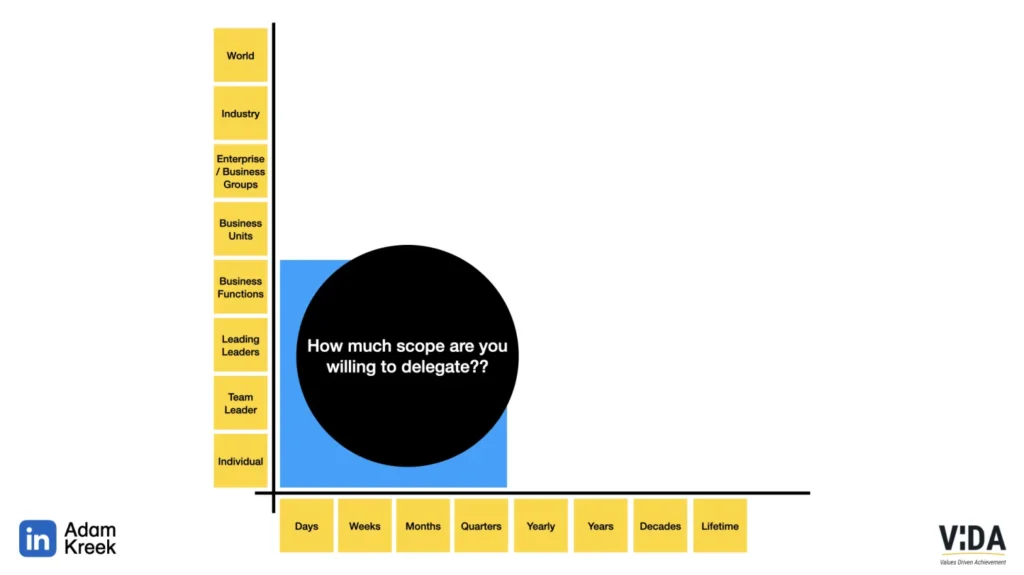
Delegation becomes a scope issue, not a personality issue.
The central question becomes:
How much scope are you willing to delegate?
If you hoard scope, you restrict growth.
If you release the wrong scope, you lose traction.
If you delegate poorly, chaos follows.
Aligning scope is the hinge that allows leaders—and entire organizations—to scale sustainably.
Scope and Strategic Deployment (Hoshin Kanri)
As your scope expands, so does your responsibility for organizational alignment.
This is where the discipline of Hoshin Kanri becomes essential.
Hoshin Kanri provides a systematic way to:
Set priorities → Align people → Review progress → Adjust without drama.
At the core is Catchball, the strategic back-and-forth between leaders and teams.
- Leadership throws vision and priorities downstream.
- Teams throw data, reality, risks, and local insights upstream.
Good catchball = strategic ping-pong.
Bad catchball = corporate dodgeball.
(You throw strategy at people; they duck.)
How Hoshin Kanri Protects Scope
- Boards govern the decade.
- Executives steer the year.
- Directors architect the quarter.
- Managers tune the month.
- Teams execute the week.
This ensures each layer leads at the right level and prevents leaders—especially executives—from drowning in tactical noise.
Strategic deployment is the mechanism.
Catchball is the discipline.
Scope is the operating system.
Scope and Leadership Development Frameworks
(Leadership River, Grit & Grace, Built for Hard, Purpose)
Your scope evolves as your leadership evolves. Several ViDA frameworks support this journey:
1. The Leadership River
Scope determines how far upstream you must look.
Early leaders look inward (skills, tasks).
Seasoned leaders look outward (systems, relationships, future forces).
2. Grit & Grace
Scope requires balanced strength:
Grit for resilience.
Grace for release.
Too much grit = burnout.
Too much grace = drift.
3. Built for Hard
As scope expands, so must your systems, boundaries, and resilience.
Leadership development is not about enduring more—it’s about designing leadership that scales.
4. Purpose and Values
Purpose clarifies your long-range scope.
Values filter your short-range decisions.
Most leaders burn out not from workload but from scope misaligned with purpose.
These frameworks strengthen your ability to operate at the correct leadership scope, especially in moments of founder transition or rapid scaling.
How to Diagnose Your Current Leadership Scope
Here are the most telling diagnostic questions:
- What level am I supposed to be operating at?
- Who do I actually lead?
- What time horizon am I responsible for?
- What decisions should be mine, and which should I delegate?
- Where am I leading too small?
- Where am I leading too big?
- What work is draining me because it no longer fits my scope?
Answer honestly. Scope gaps become instantly visible.
Conclusion: Scope Is a Leadership Choice
Scope isn’t something that happens to you.
It’s something you choose and shape.
Your effectiveness—and your sanity—depend on aligning your scope with:
- your role
- your purpose
- your values
- your season of leadership
- your organization’s stage of growth
So here’s the real question:
What is your scope… and what needs to change?
–––––
Adam Kreek and his team are on a mission to positively impact organizational cultures and leaders who make things happen.
Kreek is an Executive Business Coach who lives in Victoria, BC, near Vancouver, British Columbia, Canada, and Seattle, Washington, USA, in the Pacific Northwest. He works with clients globally, often travelling to California in the San Francisco Bay Area, Atlanta, Georgia, Toronto, Ontario and Montreal, Quebec. He is an Olympic Gold Medalist, a storied adventurer and a father.
He authored the bestselling business book, The Responsibility Ethic: 12 Strategies Exceptional People Use to Do the Work and Make Success Happen.
Discover our thoughts on Values here.
Want to increase your leadership achievement? Learn more about Kreek’s coaching here.
Want to book a keynote that leaves a lasting impact? Learn more about Kreek’s live event service here.